Hierarchies of Evidence: Database of Hierarchies
This post is now outdated as a new systematic review has replaced this database. See here for the full database, and see here for more details of the changes.
Hierarchies of Evidence are a tool employed by many advocates of Evidence-Based Medicine. They are used to appraise evidence from a range of sources, as well as to teach medical students about evidence and evidence appraisal. My PhD thesis concerns the variation in hierarchies defended, and the range of philosophical interpretations of those hierarchies. In order to complete this project, it is necessary to create and maintain a database of hierarchies of evidence. This database is available here for the benefit of other researchers interested in Evidence-Based Medicine and hierarchies of evidence. Where possible, links are provided to a pdf of the relevant source. If not, links are provided to the journal listing or to google books. Please contact me if you notice any broken links. This database is up-to-date as of 29/06/16. If you know of any hierarchies not included in this list, please contact me. I am particularly interested in non-English hierarchies which are not available in English translation. The database currently only includes hierarchies available in English. For the purposes of this database, quite a broad selection criterion has been employed to maximise scope. The definition used here is:
“A procedure for making an inference about some epistemic property of the evidence provided by studies, or some epistemic relation which holds between the evidence provided by two or more studies, primarily based on a ranking of the design or methodology used in the studies.”
I also include for reference purposes a number of sources which are commonly called or cited as hierarchies or precursors to hierarchies, but which do not meet any reasonable definition of a hierarchy of evidence, in a separate section.
| Date | Author | Source | Reference |
|---|---|---|---|
| 1979 | Canadian Task Force | CMAJ | Canadian Task Force on the Periodic Health Examination. (1979) “The Periodic Health Examination”. CMAJ 121 1193-1252” |
| 1981 | Anonymous | CMAJ | (1981) “How to read clinical journals: IV. To determine etiology or causation”. CMAJ, 124, 985-990. |
| 1986 | Sackett | Chest | Sackett, D. L. (1986) “Rules of evidence and clinical recommendations on the use of antithrombotic agents”. Chest, 89(2 Suppl), 2S-3S. |
| 1987 | LaForce | JAMA | LaForce, F. M. (1987) “Immunizations, immunoprophylaxis, and chemoprophylaxis to prevent selected infections. US Preventive Services Task Force”. JAMA, 257(18), 2464-2470 |
| 1989 | Sackett | Chest | Sackett, D. L. (1989) “Rules of evidence and clinical recommendations on the use of antithrombotic agents”. Chest, 95(2 Suppl), 2S-4S. |
| 1992 | Cook et al. | Chest | Cook, D. J., et al. (1992) “Rules of evidence and clinical recommendations on the use of antithrombotic agents”. Chest, 102(4 Suppl), 305S-311S |
| 1992 | McGowan et al. | Infectious Disease | McGowan, J.E. et al. (1992) “Guidelines for the use of systemic glucocorticosteroids in the management of selected infections”. Journal of Infectious Disease, 165, 1-13 |
| 1993 | Carruthers et al. | CMAJ | Carruthers G.S., et al. (1993) “Report of the Canadian Hypertension Conference: 1. Introduction.” CMAJ. 149(3), pp.289-293. |
| 1994 | Bigos et al. | AHCRP | Bigos, S., Bowyer, O., & Braen, G. et al. (1994) Acute low back problems in adults. Clinical practice guideline. AHCPR Pub. No. 95–0643. Rockville (MD): US Department of Health and Human Services. Public Health Service, Agency for Health Care Policy and Research. |
| 1994 | Oxman | BMJ | Oxman, A.D. (1994) “Checklists for review articles”, in BMJ, 309(6955): 648-651 |
| 1995 | Anonymous | Bandolier | Anonymous. (1995) “Evidence-Based Everything”. Bandolier, 12, 91-98 |
| 1995 | Byar/Piantadosi | Controlled Clinical Trials | Piantadosi, S. (1995). “David Byar as a teacher.” Controlled Clinical Trials, 16 (4), p. 202 ~~ Byar’s hierarchy is referenced by Olgin and Clarke but never published by Byar. Piantadosi published a version. |
| 1995 | Guyatt et al. | JAMA | Guyatt, G. H., et al. (1995) “Users’ guides to the medical literature. IX. A method for grading health care recommendations. Evidence-Based Medicine Working Group”. JAMA, 274(22), 1800-1804 |
| 1995 | Olkin | JCE | Olkin, I. (1995) “Statistical and theoretical considerations in meta-analysis”. Journal of clinical epidemiology (0895-4356), 48 (1), p. 133. ~~ An expansion of Byar’s hierarchy as published by Piantadosi. |
| 1996 | Hadorn et al. | JCE | Hadorn, D. C., Baker, D., Hodges, J. S., & Hicks, N. (1996). “Rating the quality of evidence for clinical practice guidelines.” Journal of clinical epidemiology, 49(7), 749-754. |
| 1997 | Evans et al. | J clin oncol | Evans, W. K., et al. (1997) “Lung cancer practice guidelines: lessons learned and issues addressed by the Ontario Lung Cancer Disease Site Group”. J Clin Oncol, 15(9), 3049-3059 |
| 1997 | Goldbloom | J clin oncol | Goldbloom, R. (1997) “Weighing the Evidence: the Canadian Experience.” American Journal of Clinical Nutrition 65, pp.584S-586S |
| 1997 | Granados et al. | EUR-ASSESS | Granados, A., Jonsson, E., Banta, H. D., Bero, L., Bonair, A., Cochet, M. C., … Espinas, J. A. (1997) “EUR-ASSESS Project Subgroup Report on Dissemination and Impact.” International Journal of Technology Assessment in Health Care, 13(02), 220–286. |
| 1997 | Gray | Gray, J.A. Muir. (1997) Evidence-Based Healthcare. NYC: Churchill-Livingstone | |
| 1997 | Greenhalgh | BMJ | Greenhalgh, T. (1997) “How to read a paper. Getting your bearings (deciding what the paper is about)”. BMJ, 315(7102), 243-246 |
| 1997/2001 | Greenhalgh | BMJ | Greenhalgh, Trisha. (1997) How to read a paper : the basics of evidence based medicine. London: BMJ Pub. Group ~~ Greenhalgh uses nearly-identical hierarchies in her book as in her paper, but to quite different effect. |
| 1997 | Liddle, Williamson & Irwig | NSW Pub Heal Bull | Liddle, J., Williamson, M., & Irwig, L. (1997) “Method for evaluating research and guideline evidence.” New South Wales Public Health Bull, 8, 5. |
| 1997 | Lloyd-Smith | BJOT | Lloyd-Smith, W. (1997). “Evidence-based practice and occupational therapy.” British Journal of Occupational Therapy, 60(11), 474-478. |
| 1997/2000 | Van Tulder et al. | Spine | van Tulder, M., et al. (2000) “Exercise therapy for low back pain: a systematic review within the framework of the cochrane collaboration back review group”. Spine (Phila Pa 1976), 25(21), 2784-2796 |
| 1997 | Wagoner et al. | SUNY | Wagoner, B. et al. (1997) “Guide to Research Methods: The Evidence Pyramid”. SUNY Downstate Medical Center EBM Tutorial, first known publication at latest 11 May 2000, available via Internet Archive at https://web.archive.org/web/20000511202739/http://www.servers.medlib.hscbklyn.edu/ebm/2100.htm |
| 1998 | Clarke | BMJ | Clarke, M.J. (1998) ‘Ovarian ablation in breast cancer, 1896 to 1998: milestones along hierarchy of evidence from case report to Cochrane Review’ BMJ, 317 (7167): 1246-8 |
| 1998 | Edwards, Russell & Stott | Fam Pract | Edwards, A. G., Russell, I. T. & Stott, N. C. (1998) “Signal versus noise in the evidence base for medicine: an alternative to hierarchies of evidence?”. Fam Pract, 15(4), 319-322 |
| 1998 | McPeek et al. | B. McPeek, H. Troidl, M.F. McKneally (1998) “Turning clinical problems into research studies”, in: H. Troidl, M.F. McKneally, D.S. Mulder, A.S. Wechsler, B. McPeek, W.O. Spitzer (Eds.), Surgical Research. Basic Principles and Clinical Practice, 3rd ed., Springer, pp. 191–196. | |
| 1998 | Meltzer et al. | CMAJ | Meltzer S, Leiter L, Daneman D, Gerstein HC, Yale J-F, Zinman B et al (1998) “Clinical Practice Guidelines for the Management of Diabetes in Canada.” CMAJ 159(8), pp.S1-S29. |
| 1998 | Phillips et al. | CEBM | Phillips, R. et al. (1998) “Levels of Evidence”. Centre for Evidence-Based Medicine, www.cebm.net. ~~ no longer easily available online - pdf stored” |
| 1999 | Australian NHMRC | ANHMRC | Australian National Health and Medical Research Council (ANHMRC). (1999) A Guide to the Development, Implementation and Evaluation of Clinical Practice Guidelines. Commonwealth of Australia: available at: http://www.health.gov.au/nhmrc/publicat/synopses/cp30syn.html” |
| 1999 | Beckmann | Sem Thromb & Hemo | Beckmann, J. (1999, February). Basic aspects of risk-benefit analysis. In Seminars in thrombosis and hemostasis (Vol. 25, No. 01, pp. 89-95). |
| 1999 | Chesson et al. | Sleep | Chesson, A. L., Jr., et al. (1999) “Practice parameters for the treatment of restless legs syndrome and periodic limb movement disorder. An American Academy of Sleep Medicine Report. Standards of Practice Committee of the American Academy of Sleep Medicine”. Sleep, 22(7), 961-968 |
| 1999 | Chestnut et al. | AHCPR | Chestnut R.M., Carney N., Maynard H. et al (1999) “Rehabilitation for Traumatic Brain Injury.” Rockville (MD): Agency for Health Care Policy and Research (US). Evidence Reports/Technology Assessments, No. 2. |
| 1999 | Hoogendoorn et al. | Scand J Work Environ Health | Hoogendoorn, W. E., et al. (1999) “Physical load during work and leisure time as risk factors for back pain”. Scand J Work Environ Health, 25(5), 387-403 |
| 1999 | McAlister et al. | JAMA | McAlister, F. A., et al. (1999) “Users’ Guides to the Medical Literature: XIX. Applying clinical trial results B. Guidelines for determining whether a drug is exerting (more than) a class effect”. JAMA, 282(14), 1371-1377 |
| 1999 | Shekelle et al. | BMJ | Shekelle, P. G., et al. (1999) “Clinical guidelines: developing guidelines”. BMJ, 318(7183), 593-596 |
| 1999 | Wilkinson | Trans. Am Opthal. Soc | Wilkinson, C.P. (1999) “Evidence Based Medicine Regarding the Prevention of Retinal Detachment.” Transactions of the American Ophthalmological Society. XCVII, 397-406. |
| 2000 | American Heart Association | AHA | American Heart Association (2000) “Part 1: Introduction to the International Guidelines 2000 for CPR and EEC: A Consensus on Science.” Circulation 102(Supplement 1): I1-I11. |
| 2000 | Ariens et al. | SJWEH | Ariens GAM, van Mechelen W, Bongers PM, Bouter LM, van der Wal G. (2000) “Physical risk factors for neck pain.” Scand J Work Environ Health, 26(1): pp.7-19 |
| 2000 | Bennett & Bennett | Aus Occ Therapy J | Bennett, S., & Bennett, J. W. (2000) “The process of evidence‐based practice in occupational therapy: Informing clinical decisions.” Australian Occupational Therapy Journal, 47(4), 171-180. |
| 2000 | Briss et al. | AM J Prev Med | Briss, P. A., et al. (2000) “Developing an evidence-based Guide to Community Preventive Services–methods. The Task Force on Community Preventive Services”. Am J Prev Med, 18(1 Suppl), 35-43 |
| 2000 | Ellis | Adv Nursing | Ellis, J. (2000). Sharing the evidence: clinical practice benchmarking to improve continuously the quality of care. Journal of advanced nursing, 32(1), 215-225. |
| 2000 | Greer et al. | Joint Commission | Greer, N., Mosser, G., Logan, G., & Halaas, G. W. (2000) “A Practical Approach to Evidence Grading.” The Joint Commission Journal on Quality Improvement, 26(12), 700–712. |
| 2000 | Guyatt et al. | JAMA | Guyatt, G. H., et al. (2000) “Users’ Guides to the Medical Literature: XXV. Evidence-based medicine: principles for applying the Users’ Guides to patient care. Evidence-Based Medicine Working Group”. JAMA, 284(10), 1290-1296 |
| 2000 | Opie, Yusuf & Kübler | Progr in Cardio Dis | Opie, L. H., Yusuf, S., & Kübler, W. (2000) “Current status of safety and efficacy of calcium channel blockers in cardiovascular diseases: a critical analysis based on 100 studies.” Progress in cardiovascular diseases, 43(2), 171-196. |
| 2000 | Roman, Silberzweig & Siu | Eff Clin Pract | Roman, S. H., Silberzweig, S. B. & Siu, A. L. (2000) “Grading the evidence for diabetes performance measures”. Eff Clin Pract, 3(2), 85-91 |
| 2000 | Sackett et al. | EBM | Sackett, David L. (2000) Evidence-based medicine: how to practice and teach EBM (2nd ed.). Edinburgh: Churchill Livingstone |
| 2000 | Weightman, Barker & Lancaster | Health Evidence Bull. Wales | Weightman A.L., Barker J., & Lancaster J. (2000) “A systematic approach to identifying the evidence. Project Methodology 3.” Health Evidence Bulletins Wales. Cardiff: Department of Information Services, University of Wales College of Medicine |
| 2001 | Craven | EJ Onc Nursing | Craven, O. (2001) “Screening for colorectal cancer using the faecal occult blood test: a critical literature review.” European Journal of Oncology Nursing, 5(4), 234-243. |
| 2001 | Eccles, Freemantle & Mason | Eccles, M., Freemantle, N., & Mason, J. (2001) “Using systematic reviews in clinical guideline development.” Systematic Reviews in Health Care: Meta-Analysis in Context, Second Edition, 400-409. | |
| 2001 | Harbour & Miller | BMJ | Harbour, R. & Miller, J. (2001) “A new system for grading recommendations in evidence based guidelines”. BMJ, 323(7308), 334-336 |
| 2001 | Harris et al. | Preventive Services Task Force | Harris, R. P., et al. (2001) “Current methods of the US Preventive Services Task Force: a review of the process”. Am J Prev Med, 20(3 Suppl), 21-35 |
| 2001 | Haynes | ACP J Club | Haynes, R. B. (2001) “Of studies, syntheses, synopses, and systems: the 4S evolution of services for finding current best evidence”. ACP J Club, 134(2), A11-13 |
| 2001 | Jonas | WJM | Jonas, W.B. (2001) ‘The evidence house: How to build an inclusive base for complementary medicine’, in Western Journal of Medicine, 175: (2) 79-80 |
| 2001 | Khan, Dinnes & Kleijnen | EJ Obst Gyn Rep Bio | Khan, Khalid S, Dinnes, Jacqueline & Kleijnen, Jos. (2001) “Systematic reviews to evaluate diagnostic tests”. European Journal of Obstetrics & Gynecology and Reproductive Biology, 95(1), 6-11 |
| 2001 | McAlister & Sackett | Am J M | McAlister, F. A., & Sackett, D. L. (2001) “Active-control equivalence trials and antihypertensive agents.” American journal of medicine, 111(7), 553-558. |
| 2001 | McLeod | McLeod R.S. (2001) “Evidence-Based Surgery.” In: Norton J.A. et al. (eds) Surgery. Springer, Berlin, Heidelberg | |
| 2001/2008 | Guyatt et al. | Chest | Guyatt, G., et al. (2001) “Grades of recommendation for antithrombotic agents”. Chest, 119(1 Suppl), 3S-7S |
| 2002 | Ball & Phillips | EBonCall | Ball, C.M. & Phillips, R. (2002). “Levels of Evidence - March 2002”, Evidence Based On Call. Retrieved from http://www.eboncall.org/content/levels.html; No longer available online. Superseded by Howick et al. 2009. |
| 2002 | Bandelow et al. | WFSBP | Bandelow, B. et al. (2002) “WFSBP Guidelines for the Pharmacological Treatment of Anxiety, obsessive-compulsive and posttraumatic stress disorders.” World J Biol Psychiatry, 3: pp.-171-199 |
| 2002 | Furlan et al. | Spine | Furlan, A. D., Brosseau, L., Imamura, M., & Irvin, E. (2002) “Massage for low-back pain: a systematic review within the framework of the Cochrane Collaboration Back Review Group.” Spine, 27(17), 1896-1910. |
| 2002 | Guyatt et al. | UGML | Guyatt, G.H. et al. (2002) Users’ Guides to the Medical Literature: A Manual for Evidence-Based Clinical Practice: American Medical Association Press ~~ Uses the Guyatt et al. 2000 hierarchy but with different interpretation and discussion |
| 2002 | Higginson et al. | J Pain & Sympt Man. | Higginson, I. J., Finlay, I., Goodwin, D. M., Cook, A. M., Hood, K., Edwards, A. G., … & Norman, C. E. (2002) “Do hospital-based palliative teams improve care for patients or families at the end of life?” Journal of pain and symptom management, 23(2), 96-106. |
| 2002 | Weaver et al. | J Epid & Comm Heal | Weaver, N., Williams, J. L., Weightman, A. L., Kitcher, H. N., Temple, J. M. F., Jones, P., & Palmer, S. (2002) “Taking STOX: developing a cross disciplinary methodology for systematic reviews of research on the built environment and the health of the public.” Journal of Epidemiology & Community Health, 56(1), 48-55. |
| 2003 | Davies & Nutley | Public Money & M | Davies, H.T.O. & Nutley, S.M. (1999) ‘The Rise and Rise of Evidence in Health Care’, Public Money & Management, 19(1): 9-16 |
| 2003 | Davies | Dental Update | Davies, R. M. (2003). “The prevention of dental caries and periodontal disease from the cradle to the grave: what is the best available evidence?” Dental update, 30(4), 170-179. |
| 2003 | Devereaux & Yusuf | J Int Med | Devereaux, PJ & Yusuf, S. (2003) “The evolution of the randomized controlled trial and its role in evidence‐based decision making”. Journal of internal medicine, 254(2), 105-113. |
| 2003 | Evans | J Clin Nurs | Evans, D. (2003) “Hierarchy of evidence: a framework for ranking evidence evaluating healthcare interventions”. J Clin Nurs, 12(1), 77-84 |
| 2003 | Hess et al. | Respiratory Care | Hess, D.R. et al. (2003). “AARC Evidence-Based Clinical Practice Guideline: Care of the ventilator circuit and its relation to ventilator-associated pneumonia.” Respir Care, 48(9), 869-879. |
| 2003 | ICSI | ICSI | Institute for Clinical Systems Improvement. (2003) Evidence Grading System. available at: http://www.icsi.org ~~ No longer available online. ICSI adopted GRADE in 2011.” |
| 2003 | Leys | Health Policy | Leys, M. (2003) “Health care policy: qualitative evidence and health technology assessment.” Health Policy, 65(3), 217-226. |
| 2003 | Madden | Proc. Nutrition Society | Madden, A. M. (2003). “Changing perspectives in the nutritional management of disease.” Proceedings of the Nutrition Society, 62(4), 765-772. |
| 2003 | Mason & Eccles | GREG | Mason, J. & Eccles, M.,. (2003) Guideline Recommendation and Evidence Grading (GREG). Newcastle, UK: University of Newcastle Centre for Health Services Research |
| 2003 | Petticrew & Roberts | J Epi & Comm Heal | Petticrew, M., & Roberts, H. (2003). “Evidence, hierarchies, and typologies: horses for courses.” Journal of Epidemiology & Community Health, 57(7), 527-529. |
| 2004 | Anonymous | Thorax | Anonymous (2004) ‘Hierarchy of Evidence and Grading of Recommendations’, in Thorax, 59: 13-4 |
| 2004 | Ebell et al. | SORT | Ebell, M. H., et al. (2004) “Strength of recommendation taxonomy (SORT): a patient-centered approach to grading evidence in the medical literature”. Am Fam Physician, 69(3), 548-556 |
| 2004 | Edlund et al. | AAN | Edlund, W. et al. (2004) Clinical Practice Guideline Process Manual, Appendix 9. American Academy of Neurology: available at: www.aan.com” |
| 2004 | GRADE Working Group | GRADE | GRADE Working Group. (2004) “Grading quality of evidence and strength of recommendations”. British Medical Journal, 328, 1490 |
| 2004 | Hess | Respiratory Care | Hess, D. R. (2004). “What is evidence-based medicine and why should I care?” Respiratory care, 49(7), 730-741. |
| 2004 | Lang | McGill J Med | Lang, E. (2004) “The Why and How of Evidence-Based Medicine”. McGill Journal of Medicine, 8, 90-94 |
| 2004 | Montori | Treatments in Endocrinology | Montori, V. M. (2004). “Evidence-based endocrinology.” Treatments in endocrinology, 3(1), 1-10. |
| 2004 | NICE | NICE | National Institute for Health and Clinical Excellence (NICE). (2004) NICE: Guideline Development Methods (Vol. Vol.7: Reviewing and Grading the Evidence) ~~ No longer easily accessible online. |
| 2004 | Reid | Cleft palate-craniofacial J | Reid, J. (2004) “A review of feeding interventions for infants with cleft palate.” Cleft palate-craniofacial journal, 41(3), 268-278. |
| 2004 | Vardy & Tannock | Annals of Oncology | Vardy, J., & Tannock, I. F. (2004). “Quality of cancer care.” Annals of oncology, 15(7), 1001-1006. |
| 2005 | Akobeng | Arch. dis in childhood | Akobeng, A. K. (2005). “Understanding randomised controlled trials.” Archives of disease in childhood, 90(8), 840-844. |
| 2005 | Anderson & Matzen | Andersen I, & Matzen P. (2005) Evidensbaseret Medicin [Evidence-based medicine]. Gads Forlag. ~~ German language publication, unverified, cited by Kristensen et al. 2011. | |
| 2005 | Cooper et al. | JHSRP | Cooper, N., Coyle, D., Abrams, K., Mugford, M., & Sutton, A. (2005) “Use of evidence in decision models: an appraisal of health technology assessments in the UK since 1997.” Journal of health services research & policy, 10(4), 245-250. |
| 2005 | Harding et al. | STI | Harding, R., Karus, D., Easterbrook, P., Raveis, V. H., Higginson, I. J., & Marconi, K. (2005). “Does palliative care improve outcomes for patients with HIV/AIDS? A systematic review of the evidence.” Sexually Transmitted Infections, 81(1), 5-14. |
| 2005 | Haynes | ACP J Club | Haynes, R Brian. (2005) “Of studies, syntheses, synopses, summaries, and systems: the 5S evolution of information services for evidence-based health care decisions”. ACP J Club, 145(3), A8-A8 |
| 2005 | Melnyk & Fineout-Overholt | Melnyk, B.M. & Fineout-Overholt, E.,. (2005) Evidence-Based Practice in Nursing and Healthcare: A Guide to Best Practice. Philadelphia: Lippincoot, Williams & Wilkins | |
| 2005 | Spindler et al. | JAAOS | Spindler, K. P., Kuhn, J. E., Dunn, W., Matthews, C. E., Harrell Jr, F. E., & Dittus, R. S. (2005). “Reading and Reviewing the Orthopaedic Literature: A Systematic, Evidence‐based Medicine Approach.” Journal of the American Academy of Orthopaedic Surgeons, 13(4), 220-229. |
| 2005 | Weightman et al. | NICE | Weightman, Alison*, et al.* (2005) Grading evidence and recommendations for public health interventions: developing and piloting a framework: Health Development Agency London, UK |
| 2005 | Wiegand & Carlson | AACN | Wiegand, D. & Carlson, K. (2005) AACN Procedure Manual for Critical Care, 5th ed. (Philadelphia, PA: Elsevier) |
| 2005 | Williams et al. | Physio. Res. Int. | Williams, M. T., Hardy, F., Tucker, B., Smith, M., & Maxwell, L. (2005). “Cardiothoracic physiotherapy: levels of evidence underpinning entry‐level curricula.” Physiotherapy Research International, 10(2), 72-80. |
| 2005 | Zhang et al. | Ann. Rheum. Dis. | Zhang, W., Doherty, M., Arden, N., Bannwarth, B., Bijlsma, J., Gunther, K. P., … & Leeb, B. (2005) “EULAR evidence based recommendations for the management of hip osteoarthritis: report of a task force of the EULAR Standing Committee for International Clinical Studies Including Therapeutics (ESCISIT).” Annals of the rheumatic diseases, 64(5), 669-681. |
| 2006 | Banwell | Dermatology | Banwell, H. (2006). “What is the evidence for tissue regeneration impairment when using a formulation of PVP-I antiseptic on open wounds?” Dermatology, 212(Suppl. 1), 66-76. |
| 2006 | Bhandari & Giannoudis | Injury | Bhandari, M. & Giannoudis, P. V. (2006) “Evidence-based medicine: what it is and what it is not”. Injury, 37(4), 302-306 |
| 2006 | Busse & Heetveld | Injury | Busse, J. W., & Heetveld, M. J. (2006) “Critical appraisal of the orthopaedic literature: Therapeutic and economic analysis.” Injury, 37(4), 312-320. |
| 2006 | Clarke | SAGE | Clarke A. (2006) “Evidence-based evaluation in different professional domains: similarities, differences and challenges.” In: Shaw IF, Greene JC and Mark MM (eds) The Sage handbook of evaluation. London: Sage |
| 2006 | Dagenais et al. | J Chinese Integrative Med | Dagenais, S., Tricco, A. C., Bian, Z. X., Huang, W. H., & Moher, D. (2006) “Critical appraisal of clinical studies in Chinese herbal medicine.” Zhong xi yi jie he xue bao, Journal of Chinese integrative medicine, 4(5), 455-466. |
| 2006 | Fuster et al. | Europace | Fuster, Valentin*, et al.* (2006) “ACC/AHA/ESC 2006 guidelines for the management of patients with atrial fibrillation: full text A report of the American College of Cardiology/American Heart Association Task Force on practice guidelines and the European Society of Cardiology Committee for Practice Guidelines (Writing Committee to Revise the 2001 Guidelines for the Management of Patients With Atrial Fibrillation) Developed in collaboration with the European Heart Rhythm Association and the Heart Rhythm Society”. Europace, 8(9), 651-745 |
| 2006 | Guyatt et al. | Chest | Guyatt, G.H. et al. (2006) “Grading Strength of Recommendations and Quality of Evidence in Clinical Guidelines”. Chest, 129, 174-178 |
| 2006 | Haynes et al. | Haynes, R.B., Sackett, D.L., Guyatt, G.H. & Tugwell, P. (2006) Clinical Epidemiology: how to do clinical practice research, 3rd edition, Lippincott, Williams & Wilkins: Philadelphia | |
| 2006 | NICE | NICE | National Institute for Health and Clinical Excellence (NICE). (2006) Hypertension: Management of Hypertension in Adults in Primary Care, NICE Clinical Guideline 34 |
| 2006 | Petrisor, Keating & Schmetish | Injury | Petrisor, B. A., Keating, J. & Schemitsch, E. (2006) “Grading the evidence: levels of evidence and grades of recommendation”. Injury, 37(4), 321-327 |
| 2006 | Schunemann, Fretheim & Oxman | WHO | Schunemann, H. J., Fretheim, A. & Oxman, A. D. (2006) “Improving the use of research evidence in guideline development: 9. Grading evidence and recommendations”. Health Res Policy Syst, 4, 21 |
| 2006 | Schunemann et al. | ATS | Schunemann, H. J., et al. (2006) “An official ATS statement: grading the quality of evidence and strength of recommendations in ATS guidelines and recommendations”. Am J Respir Crit Care Med, 174(5), 605-614 |
| 2006 | Tucker & Roth | Addiction | Tucker, J. A., & Roth, D. L. (2006) “Extending the evidence hierarchy to enhance evidence‐based practice for substance use disorders.” Addiction, 101(7), 918-932. |
| 2006 | Zlowodski, Jonsson & Bhandari | Med Prin & Prac | Zlowodzki, M., Jönsson, A., & Bhandari, M. (2006). “Common pitfalls in the conduct of clinical research.” Medical Principles and Practice, 15(1), 1-8. |
| 2007 | ACOEM | ACOEM | American College of Occupational and Enviromental Medicine (ACOEM) (2007) Low back disorders. Occupational medicine practice guidelines: evaluation and management of common health problems and functional recovery in workers. 2nd ed. Elk Grove Village (IL): American College of Occupational and Environmental Medicine (ACOEM); 2007. |
| 2007 | Broom & Tovey | JCE | Broom, A., & Tovey, P. (2007). “Therapeutic pluralism? Evidence, power and legitimacy in UK cancer services.” Sociology of Health & Illness, 29(4), 551-569. |
| 2007 | Daly et al. | JCE | Daly, J., et al. (2007) “A hierarchy of evidence for assessing qualitative health research”. J Clin Epidemiol, 60(1), 43-49 |
| 2007 | Lewis, Graham & Stanford | Scan. J Rheum | Lewis, K. A., Graham, E. M., & Stanford, M. R. (2007). “Systematic review of ethnic variation in the phenotype of Behcet’s disease.” Scandinavian journal of rheumatology, 36(1), 1-6. |
| 2007 | Petrisor & Bhandari | Indian J Orthop | Petrisor, B. & Bhandari, M. (2007) “The hierarchy of evidence: Levels and grades of recommendation”. Indian J Orthop, 41(1), 11-15 |
| 2007 | Thachil, Mohan & Bhugra | J Affective Disorders | Thachil, A. F., Mohan, R., & Bhugra, D. (2007) “The evidence base of complementary and alternative therapies in depression.” Journal of affective disorders, 97(1), 23-35. |
| 2007 | Virgilio, Chiapi & Palmarozzi | J Am Ost Ass | Virgilio, R.F., Chiapa, A.L. & Palmarozzi, E.A. (2007) ‘Evidence-Based Medicine, Part 1. An introduction to Creating an Answerable Question and Searching the Evidence’, in Journal of the American Osteopathy Association, 107:295-7 |
| 2008 | Arbesman, Scheer & Lieberman | OT Practice | Arbesman, M., Scheer, J. & Lieberman, D. (2008) ‘Using AOTA’s Critically Appraised Topic (CAT) and Critically Appraised Paper (CAP) series to link evidence to practice’, OT Practice, 13(5): 18-22 |
| 2008 | Guyatt et al. | UGML | Guyatt, G.H. et al. (2008) ‘How to use a patient management recommendation’ in UGML, pp.595-618 |
| 2008 | Guyatt et al. | Chest | Guyatt, G. H., et al. (2008) “Grades of recommendation for antithrombotic agents: American College of Chest Physicians Evidence-Based Clinical Practice Guidelines (8th Edition)”. Chest, 133(6 Suppl), 123S-131S |
| 2008 | Ho, Peterson & Masoudi | Circulation | Ho, P. M., Peterson, P. N. & Masoudi, F. A. (2008) “Evaluating the evidence: is there a rigid hierarchy?”. Circulation, 118(16), 1675-1684 |
| 2008 | Manchikanti et al. | Pain Physician | Manchikanti, L., Singh, V., Derby, R., Helm, S., Trescot, A. M., Staats, P. S., … & Hirsch, J. A. (2008). “Review of occupational medicine practice guidelines for interventional pain management and potential implications.” Pain Physician, 11(3), 271-289. |
| 2008 | SIGN 50 | SIGN | Scottish Intercollegiate Guidelines Network (SIGN). (2008) SIGN 50: A Guideline Developer’s Handbook. available at: www.sign.ac.uk” |
| 2008 | Sprague, McKay & Thoma | Clinics in Plastic Surgery | Sprague, S., McKay, P., & Thoma, A. (2008) “Study design and hierarchy of evidence for surgical decision making.” Clinics in plastic surgery, 35(2), 195-205. |
| 2008 | Sullivan & Cambron | NUHS | Sullivan, B.M. & Cambron, J.A. (2008) ‘Overview of Study Designs in Clinical Research’ [Presentation] (EBP@NUHS CH5 Study Design) |
| 2008 | Tang & Beaglehole | J Epid Comm Health | Tang, KC, Choi, BCK & Beaglehole, R. (2008) “Grading of evidence of the effectiveness of health promotion interventions”. J Epidemiol Community Health, 62(9), 832-834 |
| 2008 | US Preventive Services Task Force | USPSTF | U.S. Preventive Services Task Force. (2008) U.S. Preventive Services Procedure Manual. AHRQ Publication No. 08-05118-EF |
| 2009 | Armola et al. | Am J Crit Care | Armola, R. R., Bourgault, A. M., Halm, M. A., Board, R. M., Bucher, L., Harrington, L., … & Medina, J. (2009) “Upgrading the American association of critical-care nurses’ evidence-leveling hierarchy.” American Journal of Critical Care, 18(5), 405-409. |
| 2009 | Bigby | Bigby, M. (2009) “The Hierarchy of Evidence”, in Williams, H., Bigby, M., Diepgen, T., Herxheimer, A., Naldi, L., & Rzany, B. (Eds.). (2009). Evidence-based dermatology. John Wiley & Sons. | |
| 2009 | Centre for Reviews and Dissemination | CRD | Centre for Reviews and Dissemination, University of York (2009) Systematic Reviews: CRD’s guidance for undertaking reviews in health care, 3rd edition, CRD: York. |
| 2009 | Croswell & Kramer | J Hepatology | Croswell, J.M., & Kramer, B.S. (2009) “Clinical trial design and evidence-based outcomes in the study of liver diseases.” Journal of hepatology, 50(4), 817-826. |
| 2009 | DiCenso, Bayley & Haynes | Ann Int Med | DiCenso, A., Bayley, L. & Haynes, R. B. (2009) “ACP Journal Club. Editorial: Accessing preappraised evidence: fine-tuning the 5S model into a 6S model”. Ann Intern Med, 151(6), JC3-2, JC3-3 |
| 2009 | Grunze et al. | WFSBP | Grunze H, Vieta E, Goodwin GM, Bowden C, Licht R W et al. (2009) “The World Federation of Societies of Biological Psychiatry (WFSBP) Guidelines for the Biological Treatment of Bipolar Disorders: Update 2009 on the Treatment of Acute Mania.” The World Journal of Biological Psychiatry, 10: pp.85-116 |
| 2009 | Hoppe et al. | JBJS | Hoppe, D. J., Schemitsch, E. H., Morshed, S., Tornetta III, P., & Bhandari, M. (2009) “Hierarchy of evidence: where observational studies fit in and why we need them.” JBJS, 91(Supplement_3), 2-9. |
| 2009 | Howick et al. | CEBM | Howick, J. et al. (2009) “CEBM Levels of Evidence”. Centre for Evidence-Based Medicine, www.cebm.org” |
| 2009 | Manchikanti et al. | Pain Physician | Manchikanti, L., Datta, S., Smith, H. S., & Hirsch, J. A. (2009) “Evidence-based medicine, systematic reviews, and guidelines in interventional pain management: part 6. Systematic reviews and meta-analyses of observational studies.” Pain physician, 12(5), 819. |
| 2010 | Marchevsky & Wick | Am J Clin Pathol | Marchevsky, A. M. & Wick, M. R. (2010) “Evidence levels for publications in pathology and laboratory medicine”. Am J Clin Pathol, 133(3), 366-367 |
| 2009 | Merlin, Weston & Tooher | BMC | Merlin, T., Weston, A. & Tooher, R. (2009) “Extending an evidence hierarchy to include topics other than treatment: revising the Australian ‘levels of evidence’”. BMC Med Res Methodol, 9, 34 |
| 2010 | Booth | Health Info & Lib J | Booth, A. (2010) “On hierarchies, malarkeys and anarchies of evidence.” Health Information & Libraries Journal, 27(1), 84-88. |
| 2010 | Niederman & Richards | J Am Coll Dent | Niederman, R. & Richards, D. (2010) “The challenge, access, risks, and deficits of evidence-based dentistry”. J Am Coll Dent, 77(4), 20-24 |
| 2010 | Sayre et al. | AHA | Sayre M R, O’Connor R E, Atkins D L, Billi J E, Callaway C W, Shuster M et al (2010) “Part 2: Evidence Evaluation and Management of Potential or Perceived Conflicts of Interest. 2010 American Heart Association Guidelines for Cardiopulmonary Resuscitation and Emergency Cardiovascular Care.” Circulation,122(Suppl 3): pp.S657-S664 |
| 2010 | Swanson, Schmicz & Chung | Plast Reconstr Surg | Swanson, J.A., Schmicz, D. & Chung, K.C.,. (2010) “How to practice evidence based medicine”. Plast Reconstr Surg, 126, 286 |
| 2010 | Tidy | Tidy, C. (2010) “Different Levels of Evidence” Retrieved 06, 2012, from htttp://www.patient.co.uk/doctor/Different-Levels-of-Evidence-%28Critical-Reading%29.htm ~~ Tidy offers a number of different hierarchies here, some old, some novel. | |
| 2011 | Balshem et al. | GRADE | Balshem, H., et al. (2011) “GRADE guidelines: 3. Rating the quality of evidence”. J Clin Epidemiol, 64(4), 401-406 |
| 2011 | Biondi-Zoccai, Landoni & Modena | HSR | Biondi-Zoccai, G., Lotrionte, M., Biondi-Zoccai, G., Landoni, G., & Modena, M. G. (2011) “A journey into clinical evidence: from case reports to mixed treatment comparisons.” HSR proceedings in intensive care & cardiovascular anesthesia, 3(2), 93. |
| 2011 | Biondi-Zoccai et al. | HSR | Biondi-Zoccai, G., Lotrionte, M., Landoni, G., & Modena, M. G. (2011). “The rough guide to systematic reviews and meta-analyses.” HSR proceedings in intensive care & cardiovascular anesthesia, 3(3), 161. |
| 2011 | Eaves | Aesthet Surg J | Eaves, F. F., 3rd. (2011) “Got evidence? Stem cells, bias, and the level of evidence ladder: commentary on: ASAPS/ASPS position statement on stem cells and fat grafting”. Aesthet Surg J, 31(6), 718-722 |
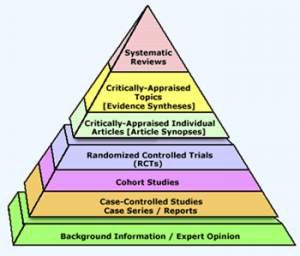
| 2011 | Glover et al. | EBM Page Generator | Glover, J. et al. (2011) “EBM Page Generator”. Formerly available at http://www.ebmpyramid.org ~~ One of the most replicated images of evidence hierarchies - this is the earliest source I have been able to locate. Can be viewed elsewhere, e.g. here. |
| 2011 | Gronsett Woodroffe & Getchius | AAN | Gronseth, G.S., Woodroffe, L.M & Getchius, T.S. (2011) Clinical Practice Guideline Process Manual. AAN: available at: http://tools.aan.com/globals/axon/assets/9023.pdf. |
| 2011 | Guyatt et al. | GRADE | Guyatt, G.H. et al. (2011) “GRADE Guidelines: 1. Introduction–GRADE evidence profiles and summary of findings tables”. Journal of Clinical Epidemiology, 64, 383-394 |
| 2011 | Howick et al. | CEBM | Howick, J., et al. (2011) “The Oxford 2011 Levels of Evidence”. Oxford Centre for Evidence-Based Medicine, available at www.cebm.net” |
| 2011 | Khan et al. | CRC | Khan, Khalid. (2011) Systematic reviews to support evidence based medicine: How to review and apply findings of healthcare research: CRC Press, p.19 |
| 2011 | Kristensen et al. | CRC | Kristensen, H. K., Persson, D., Nygren, C., Boll, M., & Matzen, P. (2011) “Evaluation of evidence within occupational therapy in stroke rehabilitation.” Scandinavian journal of occupational therapy, 18(1), 11-25. |
| 2011 | Mitchell & Friese | ONS | Mitchell, S.A. & Friese, C.R. (2011) “Decision Rules for Summative Evaluation of a Body of Evidence”, ONS: Oncology Nursing Society, available at: https://www.ons.org/explore-resources/pep/decision-rules-summative-evaluation-body-evidence |
| 2011 | NICE | NICE | National Institute for Health and Clinical Excellence (NICE). (2011) CG117: Tuberculosis: clinical diagnosis and management of tuberculosis, and measures for its prevention and control. London: RCP |
| 2011 | Tomlin & Borgetto | Am J Occup. Therapy | Tomlin, G. & Borgetto, B. (2011) “Research Pyramid: A New Evidence-Based Practice Model for Occupational Therapy.” American Journal of Occupational Therapy, 65, pp.189-196. |
| 2011 | Turner | EBVMA | Turner, S. (2011) ‘Hierarchy of Evidence’ in EBVMA, formerly available at: ebvma.org/home/content/part-1-hierarchy-evidence ~~ no longer available online. |
| 2011 | Wright, Swiontkowski & Heckman | Orth Trauma Directions | Wright, J., Swiontkowski, M., & Heckman, J. (2011) “Introducing levels of evidence to the journal.” Orthopedic Trauma Directions, 9(04), 27-28. |
| 2012 | Baral et al. | HASTE | Baral, Stefan D*, et al.* (2012) “The highest attainable standard of evidence (HASTE) for HIV/AIDS interventions: toward a public health approach to defining evidence”. Public Health Reports, 127(6), 572 |
| 2012 | Gethin | Acta Medica Croatica | Gethin, G. (2012) “Understanding Data; An introduction to critical appraisal.” Acta medica Croatica, 66, 147-151. |
| 2012 | Haigh | Group Analysis | Haigh, R. (2012) ‘Being Economical with the Evidence’, in Group Analysis, 45: 70-83 |
| 2013 | Elangovan et al. | J Periodontology | Elangovan, S., Avila-Ortiz, G., Johnson, G. K., Karimbux, N., & Allareddy, V. (2013) “Quality assessment of systematic reviews on periodontal regeneration in humans.” Journal of periodontology, 84(2), 176-185. |
| 2013 | Goldet & Howick | JEBM | Goldet, Gabrielle & Howick, Jeremy. (2013) “Understanding GRADE: an introduction”. Journal of Evidence*‐Based Medicine,* 6(1), 50-54 |
| 2013 | Gugiu et al. | Eval & the heal profs | Gugiu, P. C., Westine, C. D., Coryn, C. L., & Hobson, K. A. (2013) “An application of a new evidence grading system to research on the chronic care model.” Evaluation & the health professions, 36(1), 3-43. |
| 2013 | Joanna Briggs Institute | JBI | Joanna Briggs Institute Levels of Evidence and Grades of Recommendation Working Group (October 2013) JBI Levels of Evidence, available at Joanna Briggs Institute: https://joannabriggs.org/sites/default/files/2019-05/JBI-Levels-of-evidence_2014_0.pdf |
| 2013 | La Rochelle | EBM | La Rochelle, P. (2013) “Basic learning concepts in EBM: the bidimentional hierarchy of evidence.” Evidence-based medicine, ebmed-2013. |
| 2013 | Wells et al. | BMC | Wells, C., Kolt, G. S., Marshall, P., Hill, B., & Bialocerkowski, A. (2013). “Effectiveness of Pilates exercise in treating people with chronic low back pain: a systematic review of systematic reviews.” BMC medical research methodology, 13(1), 7. |
| 2014 | Canadian Task Force | CTFPHE | Canadian Task Force on the Periodic Health Examination. (2014) Procedure Manual. http://canadiantaskforce.ca/methods/ ~~ endorses GRADE but also offers an additional novel hierarchy.” |
| 2014 | Hansen | Scan. J Social Med | Hansen, H.F. (2014) “Organisation of evidence-based knowledge production: Evidence hierarchies and evidence typologies.” Scandinavian Journal of Social Medicine, 42(13_suppl), 11-17. |
| 2014 | Spruce et al. | AORN | Spruce, L. et al. (2014) “Introducing AORN’s new model for evidence rating.” AORN Journal, 99(2): 243-255 |
| 2014 | Steele & Tiffin | CTFPHE | Steele, R., & Tiffin, P. A. (2014) “‘Personalised evidence’for personalised healthcare: integration of a clinical librarian into mental health services–a feasibility study.” Psychiatric Bulletin, 38(1), 29-35. |
| 2015 | Costantino, Montano & Casazza | Int & Emerg Med | Costantino, G., Montano, N., & Casazza, G. (2015) “When should we change our clinical practice based on the results of a clinical study? The hierarchy of evidence.” Internal and emergency medicine, 10(6), 745-747. |
| 2015 | Feldman et al. | Ann. Rev. Pharma & Tox | Feldman, R. D., Hussain, Y., Kuyper, L. M., McAlister, F. A., Padwal, R. S., & Tobe, S. W. (2015) “Intraclass differences among antihypertensive drugs.” Annual review of pharmacology and toxicology, 55, 333-352. |
| 2015 | Gugiu | Eval & Prog. Plan. | Gugiu, P. C. (2015). “Hierarchy of evidence and appraisal of limitations (HEAL) grading system.” Evaluation and program planning, 48, 149-159. |
| 2015 | Habib et al. | ESC | Habib, G. et al. for ESC Scientific Document Group (2015) “ESC Guidelines for the management of infective endocarditis: The Task Force for the Management of Infective Endocarditis of the European Society of Cardiology (ESC) Endorsed by: European Association for Cardio-Thoracic Surgery (EACTS), the European Association of Nuclear Medicine (EANM)”, European Heart Journal, 36(44) pp.3075–3128 |
| 2015 | Pinnock et al. | BMC | Pinnock, H., Epiphaniou, E., Pearce, G., Parke, H., Greenhalgh, T., Sheikh, A., … & Taylor, S. J. (2015) “Implementing supported self-management for asthma: a systematic review and suggested hierarchy of evidence of implementation studies.” BMC medicine, 13(1), 127. |
| 2015 | Puligandla et al. | J Ped Surgery | Puligandla, P. S., Grabowski, J., Austin, M., Hedrick, H., Renaud, E., Arnold, M., … & Lopez, M. E. (2015) “Management of congenital diaphragmatic hernia: A systematic review from the APSA outcomes and evidence based practice committee.” Journal of pediatric surgery, 50(11), 1958-1970. |
| 2015 | van Ballmoos, Ware & Harding | J Clin Med Res | von Ballmoos, M.C.W., Ware, J.H., & Haring, B. (2015) “Clinical research quo vadis? Trends in reporting of clinical trials and observational study designs over two decades.” Journal of clinical medicine research, 7(6), 428. |
| 2015 | Walach & Loef | J Clin Epid | Walach, H., & Loef, M. (2015) “Using a matrix-analytical approach to synthesizing evidence solved incompatibility problem in the hierarchy of evidence.” Journal of clinical epidemiology, 68(11), 1251-1260. |
| 2016 | Garattini et al. | Eur J Int Med | Garattini, S., Jakobsen, J. C., Wetterslev, J., Bertelé, V., Banzi, R., Rath, A., … & Eikermann, M. (2016) “Evidence-based clinical practice: Overview of threats to the validity of evidence and how to minimise them.” European journal of internal medicine, 32, 13-21. |
| 2016 | Handu et al. | AND | Handu, D., Moloney, L., Wolfram, T., Ziegler, P., Acosta, A., & Steiber, A. (2016) “Academy of Nutrition and Dietetics Methodology for Conducting Systematic Reviews for the Evidence Analysis Library.” Journal of the Academy of Nutrition and Dietetics, 116(2), 311–318. |
| 2016 | Izzo et al. | Phytotherapy | Izzo, A. A., Hoon‐Kim, S., Radhakrishnan, R., & Williamson, E. M. (2016) “A critical approach to evaluating clinical efficacy, adverse events and drug interactions of herbal remedies.” Phytotherapy Research, 30(5), 691-700. |
| 2016 | Mupepele et al. | Ecological Applications | Mupepele, A. C., Walsh, J. C., Sutherland, W. J., & Dormann, C. F. (2016) “An evidence assessment tool for ecosystem services and conservation studies.” Ecological Applications, 26(5), 1295-1301. |
| 2016 | Murad et al. | EBM | Murad MH, Asi N, Alsawas M, & Alahdab F. (2016) “New evidence pyramid.” Evid Based Med. 21(4): pp.125-7. |
| 2016 | Spruce, Van Wicklin & Wood | AORN | Spruce, L., Van Wicklin, S. A., & Wood, A. (2016) “AORN’s revised model for evidence appraisal and rating.” AORN journal, 103(1), 60-72. |
| 2016 | Thompson et al. | J Am Assoc Nurse Prac | Thompson, N., Mansfield, B., Stringer, M., Stewart, B., Potter, J., & Fernengel, K. (2016) “An evidence‐based resource for the management of comorbidities associated with childhood overweight and obesity.” Journal of the American Association of Nurse Practitioners, 28(10), 559-570. |
| 2017 | Featherstone et al. | Health Communication | Featherstone, R. M., Leggett, C., Knisley, L., Jabbour, M., Klassen, T. P., Scott, S. D., … & Hartling, L. (2017) “Creation of an Integrated Knowledge Translation Process to Improve Pediatric Emergency Care in Canada.” Health Communication, 1-8. |
| 2017 | Pennington et al. | EJPH | Pennington, A., Dreaves, H., Scott-Samuel, A., Haigh, F., Harrison, A., Verma, A., & Pope, D. (2017) “Development of an Urban Health Impact Assessment methodology: indicating the health equity impacts of urban policies.” European Journal of Public Health, 27(suppl_2):56-61 |
| 2017 | Salimi et al. | Ann. Plastic Surgery | Salimi, N., Aleksejuniene, J., Yen, E. H., & Loo, A. Y. (2017) “Fistula in Cleft Lip and Palate Patients—A Systematic Scoping Review.” Annals of plastic surgery, 78(1), 91-102. |
| 2018 | Gil, Piva & Irrgang | Clin in Sports Med | Gil, A. B., Piva, S. R., & Irrgang, J. J. (2018) “Considerations for Assessment and Applicability of Studies of Intervention.” Clinics in sports medicine, 37(3), 427–440. |
| 2018 | Paez | EBM | Paez, A. (2018) “The “architect analogy” of evidence-based practice: Reconsidering the role of clinical expertise and clinician experience in evidence-based health care.” Journal of Evidence-Based Medicine 2018:1-8 |
| 2019 | Katz et al. | HEALM | Katz, D.L., Karlsen, M.C., Chung, M. et al. (2019) “Hierarchies of evidence applied to lifestyle Medicine (HEALM): introduction of a strength-of-evidence approach based on a methodological systematic review.” BMC Med Res Methodol 19, 178 |
| 2020 | Gray et al. | Drug Saf | Gray, C.M., Grimson, F., Layton, D. et al. (2020) “A Framework for Methodological Choice and Evidence Assessment for Studies Using External Comparators from Real-World Data.” Drug Saf 43, pp.623–633. |
| 2020 | Jeffcoat & Sollecito | Compend Contin Educ Dent. | Jeffcoat, M., & Sollecito T. (2020) “Evidence, Junk Science, and Hope in a Time of Pandemic: On the Front Lines in Dentistry.” Compend Contin Educ Dent. 41(8):420-424; PMID: 32870698. |
| 2020 | Tsiklakis et al. | Eur Arch Paed Dent | Tsiklakis, K., Mitsea, A., Tsichlaki, A. et al. (2020) “A systematic review of relative indications and contra-indications for prescribing panoramic radiographs in dental paediatric patients.” Eur Arch Paediatr Dent 21, 387–406 |
First published 20/12/2011, last update 29/06/16.